

He Sold His Company for RM100 Million. But He Didn’t Want His Children to Receive the Money Too Early

What Is the Difference Between a Living Trust and a Will in Malaysia?
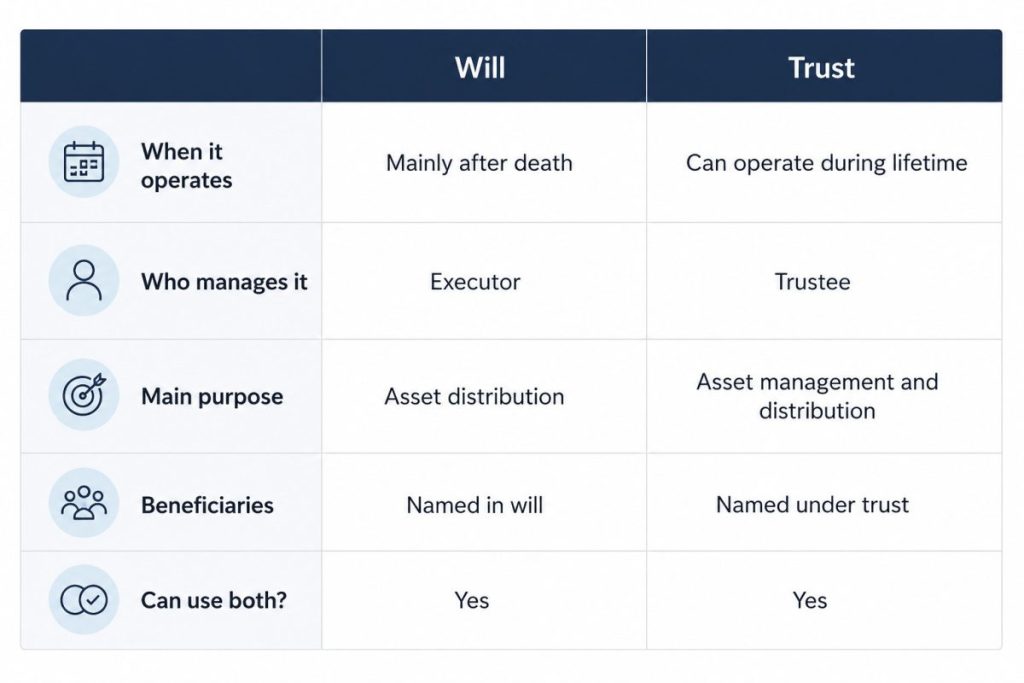
A living trust and a will are both important estate and legacy planning tools in Malaysia, but they serve different purposes. A will sets out how your estate should be distributed after your death and allows you to appoint an executor. A living trust enables a trustee to hold and manage selected assets for beneficiaries according to the terms of a trust arrangement.
The main difference is when and how the assets are managed. A living trust can operate during your lifetime and continue after your death, while a will generally takes effect after death.
For Malaysian families, choosing between a living trust and a will is not always an either-or decision. Depending on your circumstances, both arrangements may work together to support your spouse, children, dependants and long-term estate planning goals.
Estate planning is not only for wealthy families. Anyone who wants to provide clear instructions about their assets, beneficiaries and future responsibilities can benefit from understanding the available options.
In this guide, we explain how a living trust works in Malaysia, its relationship with the Trustee Act 1949, the purpose of a trust deed, the difference between revocable and irrevocable trusts, and when a will may still be necessary. We also look at the practical limitations families should consider before making a decision.
What Is a Living Trust (Inter Vivos Trust) in Malaysia?
A living trust in Malaysia, also known as an inter vivos trust, is a trust established during the settlor’s lifetime. The settlor is the person creating the trust, while the trustee is responsible for holding and administering the trust assets for the beneficiaries.
Unlike a will, which generally operates after death, a living trust can begin operating during the settlor’s lifetime once it has been properly constituted and the relevant assets have been placed under the trustee’s administration.
A living trust may involve assets such as cash, savings, property, business shares or other eligible holdings. However, the suitability of each asset depends on ownership, financing, transfer requirements and the proposed trust structure.
The terms of the trust determine how assets are administered, who may benefit, when distributions may be made and what responsibilities the trustee must fulfil.
For example, parents may establish a living trust to provide continuing financial support for their children’s education and healthcare. Instead of transferring all the funds to their children immediately, the trustee may make payments according to the trust deed.
Families considering this type of arrangement can explore trust services in Malaysia to understand the available structures and the responsibilities involved.

How Does a Living Trust Work Under Malaysian Law?
Trust arrangements in Malaysia are governed by applicable trust law, including the Trustee Act 1949, relevant legislation and the terms of the trust. The legal requirements and administrative obligations depend on the type of trust and circumstances involved.
A living trust generally involves three main parties:
- Settlor: The individual who establishes the trust and identifies the assets and intended arrangements.
- Trustee: The individual or professional trust company responsible for holding and administering the trust property according to the trust terms and applicable law.
- Beneficiaries: The individuals who may receive benefits from the trust, such as a spouse, children, parents or other family members.
For a trust to operate as intended, it is important to establish the trust arrangement correctly, identify the beneficiaries and trust property, and complete the necessary asset transfers.
Malaysia’s Trustee Act 1949 provides part of the legal framework relating to trustee responsibilities. Legislative amendments, including the Trustee (Amendment) Act 2025, also highlight the importance of trust documentation, beneficial ownership information and trustee accountability. The applicability and commencement of particular provisions should be checked against the latest law.
What Is a Trust Deed in Malaysia?
A trust deed in Malaysia is an important document that records the terms governing a trust. It helps define the trustee’s responsibilities and how the trust assets should be administered for beneficiaries.
Depending on the arrangement, a trust deed may specify:
- The settlor, trustee and beneficiaries
- The assets intended to form part of the trust
- The purpose of the trust
- Conditions for distributing money or other assets
- Trustee powers, responsibilities and limitations
- Arrangements for replacing or appointing trustees
- Conditions relating to amendment or termination
- Administrative and reporting requirements
A properly prepared trust deed can improve clarity, but signing a document alone does not necessarily complete every required asset transfer. Legal ownership, documentation and applicable formalities must also be considered.
What Are the Responsibilities of a Living Trust Trustee?
The trustee has responsibilities that extend beyond simply holding assets. Depending on the trust arrangement, the trustee may need to maintain records, manage trust property, make permitted distributions and act according to the trust terms and applicable duties.
Trustee responsibilities can continue for many years, especially where beneficiaries are young or require ongoing support.
For this reason, selecting a suitable trustee is a significant part of living trust planning. Some families appoint an eligible individual, while others consider a professional trust company for continuity and administration.
Living Trust vs Will in Malaysia: Key Differences
Although both arrangements support estate planning in Malaysia, they operate differently. Understanding the differences can help families decide which combination is appropriate for their assets and beneficiaries.
1. When They Take Effect
A living trust can operate during the settlor’s lifetime once the trust has been properly established and the relevant assets are held under the trust arrangement.
A will generally takes effect after death. It provides instructions concerning the distribution of estate assets and the appointment of an executor.
2. Asset Management and Trustee Responsibilities
A living trust allows selected assets to be administered by a trustee according to the trust deed. Depending on the structure, this may support continuity if the settlor becomes unable to manage personal affairs.
A will does not usually provide the same lifetime asset-management arrangement. Its primary role is to address matters following the testator’s death.
3. Distribution to Beneficiaries
A living trust may provide for ongoing or staged distributions. For example, funds could be allocated for education or living expenses, with further distributions at specified ages.
A will can also establish distribution instructions and, where appropriate, testamentary trust arrangements. The right choice depends on the family’s objectives.
4. Probate and Estate Administration
Assets that have been validly transferred into a living trust during the settlor’s lifetime may continue to be administered under the trust terms after death without those particular assets forming part of the settlor’s estate for probate purposes.
However, a living trust does not automatically eliminate probate or every estate administration requirement. Assets outside the trust may still need to be administered through the relevant estate procedures.
5. Guardianship and Family Arrangements
A will is commonly used to record a parent’s wishes concerning the appointment of guardians for minor children, subject to applicable law and legal requirements.
A living trust can complement these arrangements by providing for the management of selected assets intended to support the children.
What Are the Benefits of Having a Living Trust in Malaysia?
Setting up a living trust may offer practical estate-planning benefits when the arrangement is suitable for the family’s circumstances and is properly administered.
1. Continuity of Trust Asset Administration
A living trust may provide continuity in the administration of selected assets during the settlor’s lifetime and after death.
Where relevant assets have been validly transferred to the trustee, the trustee may continue administering those assets according to the trust terms. This can reduce uncertainty about how specified assets should be managed.
2. Potential Probate-Related Advantages
Properly established living trusts may reduce the need for certain trust-held assets to pass through the settlor’s estate administration process.
However, probate requirements depend on the assets involved, the validity of the trust, how property was transferred and the wider estate circumstances. A trust does not guarantee that probate delays, legal costs or disputes will be avoided entirely.
3. Privacy and Confidentiality Considerations
A living trust may provide a different level of privacy from estate administration arrangements because trust documentation is not necessarily handled in the same way as documents used in probate proceedings.
Nevertheless, confidentiality is not absolute. Trustees may be subject to legal disclosure, regulatory reporting, beneficial ownership record-keeping and court requirements where applicable.
4. Flexibility Based on the Trust Structure
Some living trusts are designed to allow changes during the settlor’s lifetime. Others may restrict amendment or revocation.
This distinction is important because families should understand what can and cannot be changed before establishing a trust.
5. Planning for Overseas Assets
For Malaysian families who hold assets overseas, a living trust may form part of a wider cross-border estate plan.
However, foreign property laws, ownership requirements, taxation and succession rules may still apply. A Malaysian trust does not automatically remove the need to comply with another country’s legal procedures.

Revocable vs Irrevocable Living Trust in Malaysia
One important consideration when setting up a living trust is whether the arrangement is revocable or irrevocable.
What Is a Revocable Living Trust?
A revocable living trust is structured to allow the settlor to revoke the trust, subject to its terms and applicable law. Depending on the deed, certain amendments may also be permitted.
This may be useful for people who want flexibility as family circumstances or asset arrangements change.
However, revocability does not automatically mean that every asset transfer can be reversed without legal, administrative or tax consequences.
What Is an Irrevocable Living Trust?
An irrevocable trust generally restricts the settlor’s ability to revoke or alter the arrangement. Any permitted changes depend on the deed and applicable law.
Families considering an irrevocable trust should carefully understand the long-term implications of transferring assets and the responsibilities of the trustee.
Neither structure guarantees protection against creditors, legal claims or taxes. The suitability of each arrangement should be assessed professionally.
Why Might You Need Both a Living Trust and a Will in Malaysia?
While a living trust can be useful for administering selected assets, it does not necessarily replace every function of a will.
For many Malaysian families, both arrangements may complement each other as part of a more complete estate plan.
Guardianship for Minor Children
A will can record the appointment of guardians for minor children, subject to the applicable legal requirements. A living trust can help arrange financial support for children through the administration of selected trust assets.
Assets Not Included in the Living Trust
It is common for individuals to acquire additional assets after establishing a trust.
If these assets are not transferred into the trust, they may remain part of the estate and require separate administration after death.
A properly prepared will can provide instructions concerning assets that fall outside the trust.
Different Legal and Religious Considerations
Malaysia’s estate planning framework differs according to applicable law and individual circumstances.
For non-Muslims, the Wills Act 1959 is relevant to the formal requirements for wills. Muslim estate planning involves additional considerations, including faraid, wasiat, hibah and applicable Shariah principles.
Families should seek advice appropriate to their legal, religious and personal circumstances rather than assuming one arrangement applies equally to everyone.
CNB Amanah’s will writing services and trust services can be explored together where both arrangements may be relevant.
If I Already Have a Living Trust, Do I Still Need a Will?
In many cases, yes. A living trust generally covers assets held under the trust arrangement, while a will can address estate assets outside the trust and provide instructions concerning executors and other relevant matters.
For instance, if you acquire new property or other assets after establishing your trust, those assets may not automatically become trust property.
A will may therefore remain useful even if a living trust has already been established.
However, this does not mean that every Malaysian family needs both arrangements. The appropriate combination depends on the assets involved, intended beneficiaries, costs and estate planning objectives.
What Should You Consider Before Setting Up a Living Trust in Malaysia?
Before establishing a living trust, families should consider whether the proposed arrangement is suitable for their circumstances.
- Purpose: What should the trust achieve for your family or beneficiaries?
- Assets: Which assets can legally and practically be transferred into the trust?
- Trustee: Who has the capacity and ability to administer the trust over time?
- Beneficiaries: Who should receive support, and under what conditions?
- Trust deed: What powers and limitations should apply to the trustee?
- Costs: What setup, administration and asset-transfer costs may arise?
- Legal and tax implications: Are there ownership, financing, tax or reporting requirements?
- Flexibility: Can the arrangement be changed if family circumstances evolve?
A living trust may not be necessary for every family. In some situations, a properly drafted will and other estate planning arrangements may adequately address the individual’s needs.
For families with more complex circumstances, private trust planning may be worth exploring alongside the wider estate plan.
Case Study: Using a Living Trust and Will Together
The following is a hypothetical example for educational purposes.
Mr Lee, a business owner in Kuala Lumpur, establishes a living trust to administer selected family assets, including certain business interests and financial holdings.
Over time, he acquires additional property and establishes another company. However, he does not transfer these new assets into the existing trust arrangement.
When reviewing his estate plan, Mr Lee realises that some assets remain outside the trust. He therefore arranges for a will to address his remaining estate assets and document his intended distribution arrangements.
After Mr Lee’s death, the trustee would continue administering validly held trust assets according to the trust terms, while the executor would handle estate assets under the applicable estate administration process.
This example illustrates why regular estate planning reviews matter. It does not suggest that trusts or wills can guarantee faster distributions, avoid all disputes or eliminate probate requirements.
What Can Malaysian Families Learn From This Example?
Creating a trust is only one part of the planning process. Families should also ensure that appropriate assets are transferred, legal documentation is maintained and arrangements are reviewed when circumstances change.
A living trust and a will can complement each other, but both must be properly prepared and administered to achieve their intended purposes.
Frequently Asked Questions About Living Trusts and Wills in Malaysia
Is a living trust better than a will in Malaysia?
Neither arrangement is automatically better. A living trust can provide ongoing administration of selected assets, while a will addresses estate distribution and executor appointments after death. The appropriate choice depends on your circumstances and objectives.
What is an inter vivos trust in Malaysia?
An inter vivos trust is a trust established during the settlor’s lifetime. It is commonly called a living trust and may be used to administer selected assets for beneficiaries under the terms of the trust arrangement.
Does a living trust avoid probate in Malaysia?
Assets validly held in a living trust may continue to be administered by the trustee outside the deceased settlor’s estate administration. However, assets outside the trust may still require probate or other estate procedures. A living trust does not automatically eliminate probate for every asset.
Can I change a living trust after creating it?
Whether a living trust can be amended or revoked depends on the trust deed and applicable law. Revocable trusts may permit changes, while irrevocable arrangements generally impose greater restrictions.
What is the purpose of a trust deed in Malaysia?
A trust deed documents the terms of a trust, including the beneficiaries, trust property, trustee responsibilities, distribution conditions and relevant administrative provisions. Proper establishment and asset transfers are also important.
Can a living trust hold property in Malaysia?
A living trust may be structured to hold eligible property, subject to ownership rules, financing arrangements, transfer formalities, taxes and other legal requirements. Professional advice should be obtained before transferring property into a trust.
How much does it cost to set up a living trust in Malaysia?
Costs depend on the trust structure, assets, legal documentation, trustee responsibilities and ongoing administration. Asset transfers may involve additional fees or taxes. A professional assessment can help establish the likely costs for your circumstances.
Do I still need a will if I have a revocable living trust?
A will may still be useful for assets outside the trust, executor appointments and other estate planning matters. A revocable living trust does not automatically cover all assets owned by the settlor.
Can a living trust protect assets from creditors?
A living trust does not guarantee protection from creditors or legal claims. Its legal effect depends on the trust structure, timing and validity of asset transfers, applicable law and the circumstances of any claim.
Conclusion: Choosing Between a Living Trust and a Will in Malaysia
A living trust and a will are valuable estate planning tools, but they serve different purposes.
A living trust can help arrange the ongoing administration of selected assets during life and after death. A will can provide instructions for the distribution of estate assets and other important matters following death.
For Malaysian families, the most suitable approach depends on their assets, beneficiaries, family responsibilities and long-term goals.
Rather than assuming that everyone needs both arrangements, it is better to review your circumstances and understand what each option can realistically achieve.
How CNB Amanah Can Support Your Estate Planning
CNB Amanah is a licensed trust company in Malaysia providing trust services, will writing and legacy planning support.
If you are considering a living trust, a will or a combination of both, the CNB Amanah team can help you explore the available arrangements based on your family’s needs and assets.
You can learn more about CNB Amanah’s Trust Services or explore its Will Writing Services to understand the different planning options.
For a wider discussion about your family’s future, you may also explore Legacy Planning services.
If you are unsure where to begin, consider speaking with the CNB Amanah team about your intended beneficiaries, existing assets and estate planning objectives. An initial discussion can help clarify which arrangements may be worth considering.
Sources and Reference Note
This article provides a general educational discussion of living trusts, wills and estate planning in Malaysia. Relevant legal frameworks include the Trustee Act 1949, the Wills Act 1959 where applicable, and other relevant Malaysian trust and estate laws.
The Trustee (Amendment) Act 2025 also introduced amendments relating to express trusts and trust administration. The commencement and applicability of specific provisions should be confirmed against the latest legislation and official notices.
Readers should consult appropriately qualified professionals for advice on trust establishment, property transfers, taxation, trustee obligations and the legal requirements applicable to their personal circumstances.
Professional Disclaimer: This article is provided for general educational and informational purposes only and does not constitute legal, tax, financial or professional advice. Living trusts, wills, asset transfers, probate, trustee responsibilities and estate administration requirements may differ according to individual circumstances, religious considerations and applicable Malaysian law. No trust or will arrangement guarantees protection against creditors, legal claims, disputes, taxes or probate delays. Readers should obtain advice from appropriately qualified professionals before making estate planning decisions.